
Testing & Reporting
$3452 hours
Performance testing, before an injury happens
Proactive screening and benchmarking for active people and athletes who are not currently in rehab. Profile your strength, capacity and movement by region, see where symmetry and capacity sit against benchmarks, and leave with training priorities for your weaker areas.
Proactive screening & benchmarking
Best suited for
- Athletes and active people wanting a performance and resilience baseline, without a current injury.
- Anyone with a history of injury who wants to check for remaining weak links before a season or training block.
- People who want objective data to shape their strength and conditioning.
What's included
The testing session
Clinical flags
Past injuries and ongoing concerns are noted up front and linked to management or review where needed.
Mobility
Joint range and flexibility, such as ankle dorsiflexion and hip rotation. We compare sides and relevant reference values to identify restrictions that may influence movement.
Strength
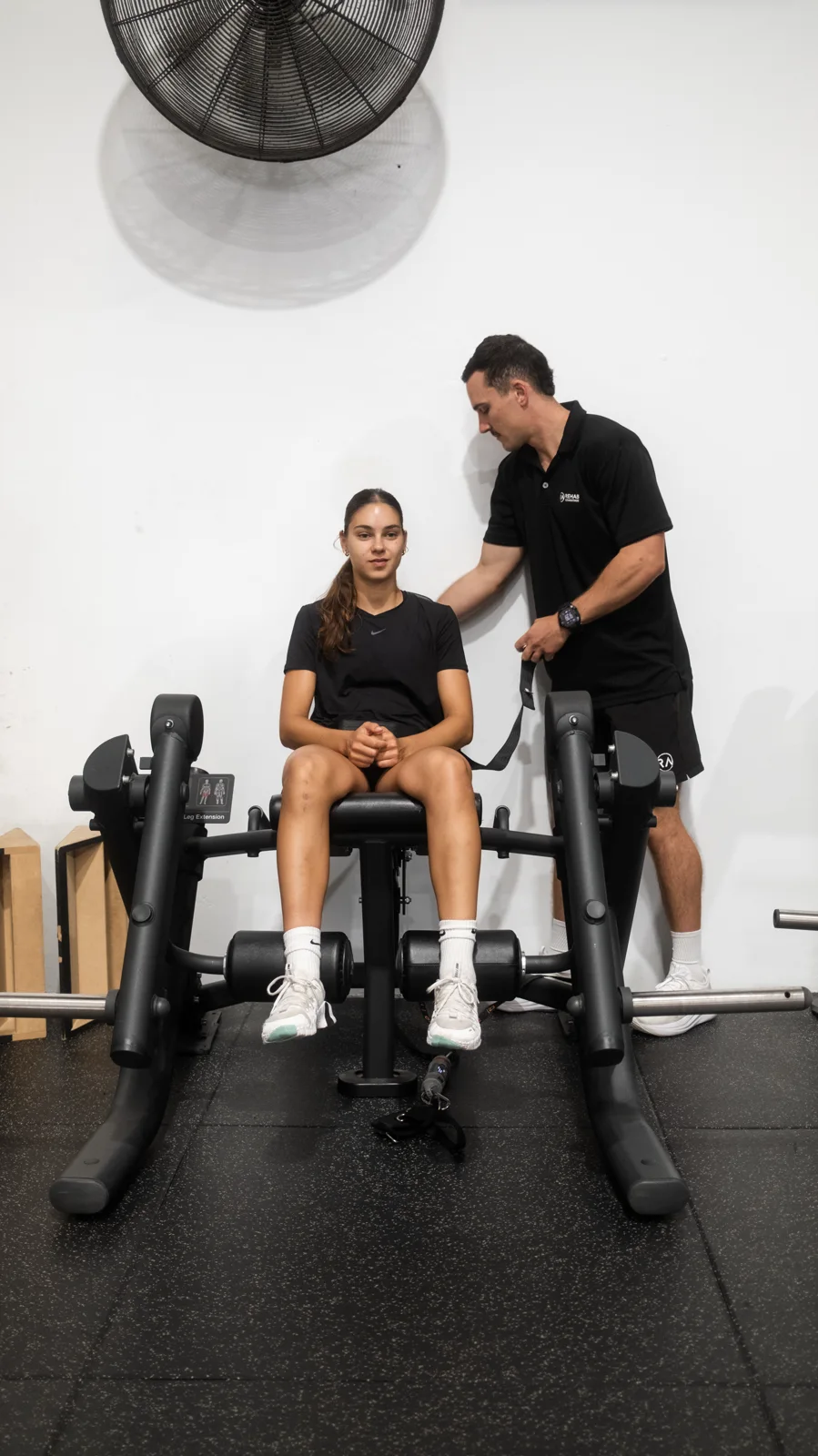
Force output across relevant muscle groups, including quads, hamstrings, calves, hips, shoulders and neck. Both side-to-side balance and absolute strength against benchmarks matter.
Capacity
The ability to sustain and repeat work. Where relevant, calf endurance and other repeated-effort tests help identify fatigue-related gaps that a single maximal effort may miss.
Dynamic performance
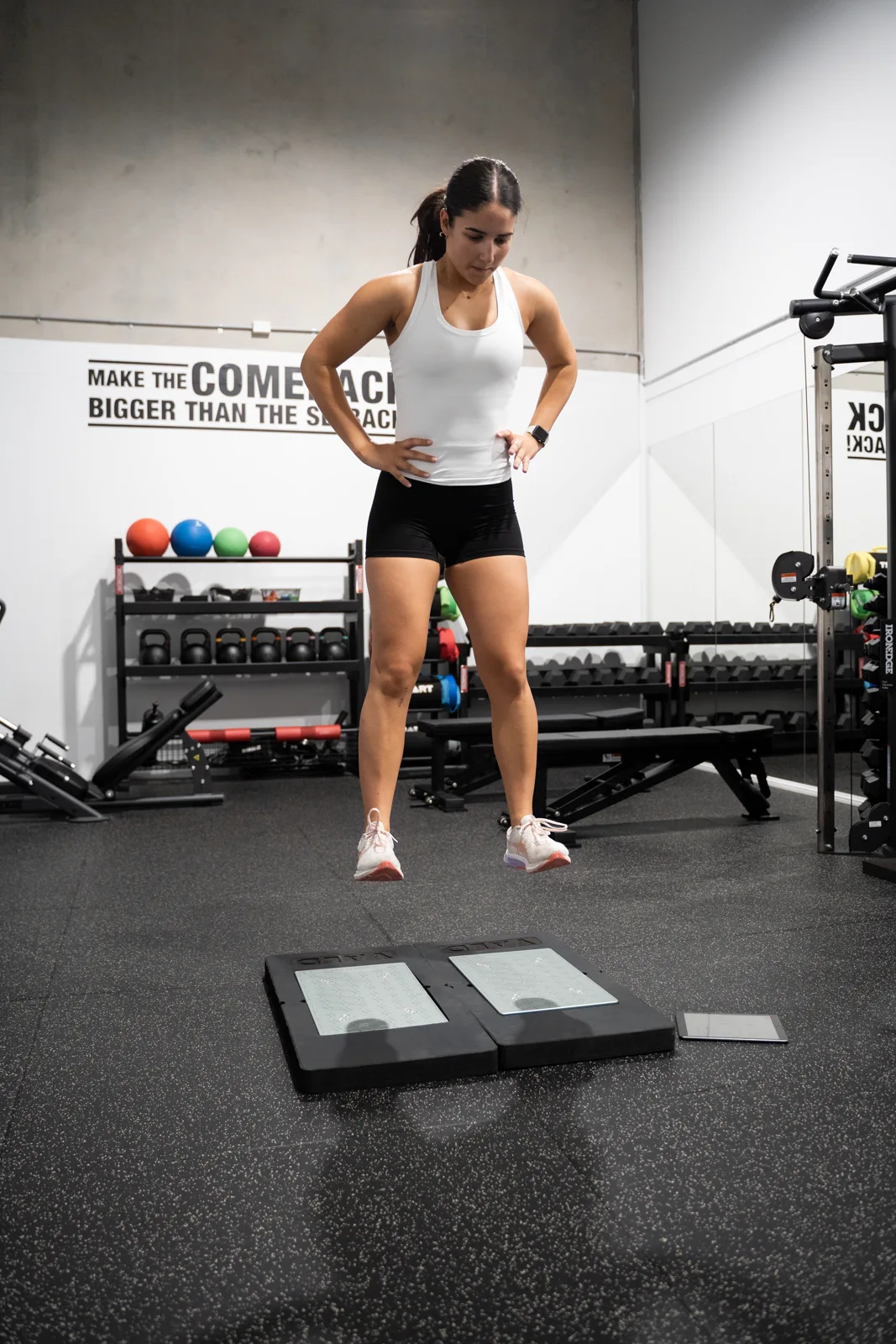
How you produce force, absorb landing and braking loads, and react quickly. Jump and reactive-strength measures explore push-off, load sharing and repeated ground contacts.
Movement quality
How you control your body during tasks such as single-leg landing. We assess balance, alignment and control alongside the force and capacity measures.
Symmetry and capacity
Left vs right and absolute output against appropriate benchmarks; mobility against reference values.
Tests are selected for your history, sport and goals. Not every session includes every measure; untested areas are not treated as normal results.
The report
Regional profiles
Findings grouped into calf & ankle, thigh & knee, hip & back, and shoulder & neck, with individual measures mapped against symmetry and benchmark targets.
Training priorities
Program targets for specific weaker areas and a training direction, not just an overall score.
Retest and compare
Repeat testing, or targeted retests of priority measures, compared with your own baseline.
How profiling is handled
Measures are plotted on two questions at once: how evenly the two sides match, and how the weaker side compares with an appropriate benchmark. Where each measure lands shapes the training direction.
Symmetry vs benchmark
IllustrativeWhat each quadrant points to
A · Strong but asymmetrical · Output is there; close the side-to-side gap with targeted single-limb work on the weaker side.
B · Symmetrical & strong · Maintain. Keep exposing the area to load and build on it as training demands rise.
C · Weak & asymmetrical · Priority area. Address the side-to-side gap and overall capacity, then retest against your baseline.
D · Symmetrical but weak · Both sides match but sit below benchmark. Progress bilateral capacity and load.
Your regional profiles
Each profile brings relevant test results together by body region, making it easier to see what to maintain, what to improve and what to reassess.
Calf & ankle
Ankle mobility, calf force output and repeated calf-raise capacity.
Connects push-off and landing demands with the ankle range and calf endurance needed for running and repeated efforts.
Thigh & knee
Quadriceps and hamstring strength, side-to-side differences and jump or braking measures.
Highlights strength and load-sharing gaps to address as running, deceleration and change-of-direction demands increase.
Hip & back
Hip rotation and flexibility, plus hip flexor, abductor and adductor strength.
Explores how hip mobility and strength support pelvis and trunk control. Findings are interpreted alongside your history, not as a diagnosis of back pain.
Shoulder & neck
Shoulder internal and external rotation strength, relevant strength ratios and neck force output.
Guides upper-body priorities for your sport, including overhead activity or contact demands where relevant.
Regional findings inform a prioritised training plan and targeted retesting. Measures and benchmarks are selected for the individual; not every region requires the same tests.
Standalone appointment pricing for patients outside a rehab program. Inclusions are a guide — your practitioner will confirm exact session content at booking.
Why test when nothing hurts
Injury prevention programs that work on strengthening, movement efficiency and technique help reduce injury rates. Testing gives that training a starting point: objective numbers instead of guesswork.
A baseline is also useful later. If you are injured down the track, your results give your rehabilitation a pre-injury reference point to work back towards.
This is a testing and reporting session, not a diagnosis or a guarantee. Results guide training decisions, and your practitioner will explain what they can and cannot tell you.
FAQs
End-Stage Rehab Testing is for people completing rehabilitation and focuses on readiness to return to sport or activity after an injury. Injury Prevention & Resilience Testing is proactive: it benchmarks people who are not currently injured and guides training to reduce injury risk and build capacity.
It opens with clinical flags: past injuries or ongoing concerns, linked to management or review where needed. Results are then grouped by domain (mobility, strength, capacity, dynamic performance and movement quality) and by region: calf & ankle, thigh & knee, hip & back, and shoulder & neck.
Measures are selected where relevant to you and your sport, so not every athlete completes the same battery. Each region is profiled for symmetry and for absolute capacity against appropriate benchmarks, with mobility compared to reference values.
The report finishes with program targets for your weaker areas and a training direction. Team benchmarking may be added where appropriate comparison data exists, but it is optional.
Yes. A full repeat test, or targeted retests of your priority measures, can be arranged to compare against your own baseline. Your practitioner will advise which measures to repeat and when, and confirm the booking options.
No. The resilience profile informs risk reduction and training and load choices. It is not a guarantee against injury, a validated injury prediction or a standalone diagnosis, and reference lines such as 90% are prompts for prioritising training, not a clearance standard.
There are many factors that contribute to sustaining a sports injury. Sports injuries are broken down into two main categories: acute and overuse.
Load management, strength training and movement coaching can help reduce injury risk. Testing identifies areas to address and gives your training an objective starting point.
No assessment can predict or prevent every injury. Results support decisions about training and return to activity; they are not a guarantee that an injury will not occur.